• SONG FOR AUTUMN: HANNAH BROWN AT GAINSBOROUGH'S HOUSE

    BY TOM MARKS
     
     
  • ‘If we are looking for wildlife we turn automatically towards the official countryside, towards the great set-pieces of forest and...
    Hannah Brown - Song For Autumn
    Installation image by Ben Deakin 
    ‘If we are looking for wildlife we turn automatically towards the official countryside, towards the great set-pieces of forest and moor,’ the nature writer Richard Mabey wrote in 1973. 
     
    ‘If the truth is told, the needs of the natural world are more prosaic than this.’ Mabey drew attention to what he called ‘the unofficial countryside’: the flora and fauna that thrives along towpaths, on scraplands and jaded recreation grounds, or even between the gaps in the pavement. 
     
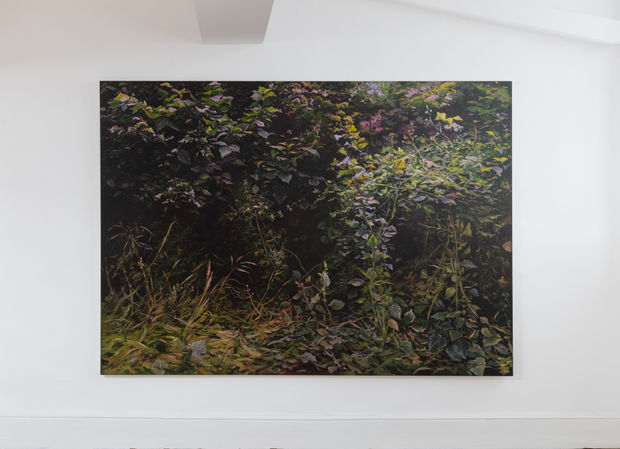
    The unofficial countryside feels like an apt characterisation of the paintings of Hannah Brown (b. 1977). Although her oil sketches and large-scale paintings have a vibrancy and verdancy that suggests the lush possibilities of rural England, in fact Brown’s subjects are often edgelands, places abutting the built environment or themselves on the cusp of construction. James Lane, for instance, is a cut-through close to her home in East London, a sliver of green amid the urban sprawl; Hollow Pond is an old Victorian gravel pit, further excavated in 1905 to provide a boating lake on the southern fringes of Epping Forest. Pedlarspool is a suburban development site near Crediton in Devon, where Brown spent part of her childhood. 
  • That such locations take on personal and artistic relevance for Brown, as everyday places she has come to know and...

    Day for Dusk, Coastal Path 2, oil on linen, 100 x 90cm


    That such locations take on personal and artistic relevance for Brown, as everyday places she has come to know and chosen to record over an extended period of time, situates her work in an alternative landscape tradition from that of classical view painting. Hers is not the open vista of Richard Wilson and his followers, or even Thomas Gainsborough. It is reminiscent, rather, of the poetry of John Clare, sensitive to a close-cropped world of hedgerows, lanes and local habitats, and to how places reveal themselves over time. Like William Holman Hunt in A Haunted Manor (1849) – a work that dwells in pondweed, and which Brown notes as an influence – she eschews the elevated perspective to paint from the ground up. 
     
    What that means, in practice, is that Brown is drawn to edges – to verges and thickets, to overhanging boughs obstructing footpaths and wider prospects. In The Verge by James Lane 5, one of her largest paintings to date, she invites us tight to the undergrowth, almost challenging us to beat a path through to the strange yellow light beyond. If her Day for Dusk (Coast Path) paintings allude to the sun-saturated cliffs of Holman Hunt’s Our English Coasts (1852), they grant only partial views of the shore beyond, obscured by tangled foliage in the gloaming. In taking up such subjects, Brown is conscious of how landscape painting, in the service of the picturesque, often elides distinctions between public and private space – and about who has access where, indeed who works the land. Her interrupted views remind us of the contemporary resonance of such questions. 

  • Brown handles paint with a fluency that evokes the great open-air painters of the 19th century. Unlike them, however, she...

    Song For Autumn - Hannah Brown - Gainsborough's House

    installation image by Ben Deakin

     
    Brown handles paint with a fluency that evokes the great open-air painters of the 19th century. Unlike them, however, she is not an artist who strikes out into the countryside, easel strapped to her back, to transform views into visions. Her method is to photograph sites that she has happened upon, sometimes capturing thousands of images over several years, before studying her photographs in her studio (she compares photography to sketching). Some images burrow into her imagination, and it is with these that she begins to experiment, sometimes digitally modifying the light – hence the otherworldly atmosphere of some of her paintings – before making small oil sketches on paper or board. After a further editing process she then translates selected compositions into larger paintings. 
     
    In a sense, then, Brown’s paintings are composite images: distillations of how she responds to specific places, rather than direct representations of them. That accounts for their distinctive stillness, their quiet tension between rampant growth and frozen time. But the mediation that occurs between her initial photography and the finished painting is also a tactic, a way for Brown to investigate what it means to work within the landscape tradition while pushing inquiringly against it. In recent work she has begun to overlay the colour palette of historical paintings onto her own photographs – as with her sketches ‘after Corot’, which assimilate the tones of his great quadriptych, The Four Times of Day (c. 1858). 
  • In a sense, then, Brown’s paintings are composite images: distillations of how she responds to specific places, rather than direct...

    Song For Autumn - Hannah Brown - Gainsborough's House

    installation image by Ben Deakin

     
    In a sense, then, Brown’s paintings are composite images: distillations of how she responds to specific places, rather than direct representations of them. That accounts for their distinctive stillness, their quiet tension between rampant growth and frozen time. But the mediation that occurs between her initial photography and the finished painting is also a tactic, a way for Brown to investigate what it means to work within the landscape tradition while pushing inquiringly against it. In recent work she has begun to overlay the colour palette of historical paintings onto her own photographs – as with her sketches ‘after Corot’, which assimilate the tones of his great quadriptych, The Four Times of Day (c. 1858). 
     
    For this exhibition Brown has made a group of oil sketches that respond to Thomas Gainsborough’s Cornard Wood, Near Sudbury, Suffolk (1748). These works draw on photographs that Brown took while searching for the location depicted by Gainsborough, and then bathed in the light of his painting using computer software. Although she identified the likely site that Gainsborough painted, in the woods and fields beyond Sudbury on a hot August afternoon, she also found it changed and different. The countryside is not a landscape painting; but our perception of it, as Brown knows so well, is forever informed by how artists have represented it. The Looking for Cornard Wood paintings are views of her own – but ghosted by another artist’s landscape. 
  • Hannah Brown was born in 1977 in Salisbury, England. She completed her BA in fine arts at Central St Martins...

    all photographs by Peter Mallet


    Hannah Brown was born in 1977 in Salisbury, England. She completed her BA in fine arts at Central St Martins in 1999 and her MA at the Royal College of Art in 2006.
     
    Recent major exhibitions include 'The Road to Hollow Pond', 2024 (Frestonian Gallery, London, UK), 'Hollow Pond', 2024 (Anat Ebgi Gallery, Los Angeles, USA), 'Arcadia and Elsewhere', 2024 (James Cohan Gallery, New York, NY); ‘Arcadia for All? Rethinking Landscape Painting Now’, 2023 (The Stanley & Audrey Burton Gallery, Leeds and Attenborough Arts Centre, University of Leicester; ‘Entwined: Plants in Contemporary Painting, 20-21’, 2023 (Visual Arts Centre, Scunthorpe); ‘If you forget my name, You will go astray’, 2022 (Anat Ebgi Gallery, Los Angeles), 'I Stood Still' 2022 (Frestonian Gallery, London) ‘This Muddy Eden’ 2020 (two person SHOW with Christopher Orr, Broadway Gallery, curated by Kristan Day) and ‘Before Long’ 2019 (Union Gallery, London). In 2021 she was featured in the John Moores Painting Prize and in 2020 in the exhibition ‘The Green Fuse’ at Frestonian Gallery. Her work is held in private collections in the UK, USA, Japan, Italy, Switzerland, Korea and U.A.E among others, and has been acquired for the permanent collections of the State Art Collection of, Ireland, Dublin; the V&A Museum, Londo and The Xiao Museum, Rizhao, China.
    She lives and works in London.